Plan Your Wedding Like a Pro: The Mood Board

As soon as you start planning the details of your wedding, you’ll discover millions of wonderful wedding-related things everywhere—whether on social media, in TV commercials, at a furniture store, or at the flower shop around the corner. It feels like you’ll never be able to decide on a wedding design, and your head might just explode from all the ideas and trends. That’s why a mood board is an essential part of every perfectly planned wedding.
It helps you collect and organize all these ideas, find your style, and visualize your vision. Your finalized wedding mood board serves as the foundation for discussions with your vendors and provides the stylistic thread that ties your big day together.
This article covers the following topics:


What is a mood board?
A mood board is a kind of collage that makes it easy for you to visualize what you want your wedding to look like. It also lets you see right away whether the colors you’ve chosen go well together, where they can be used, and whether the style you’ve chosen fits with them. The more consistent your color and style concept is, the more clearly it will stand out as a unifying theme in the end.
Why do you need a mood board?
First and foremost, it’s meant to help you figure out what style and colors you want for your wedding. But it also helps your vendors get a clear picture of your wishes—that is, the look and feel you want for your big day. This way, you can ensure that your vendors understand your vision and bring it to life exactly as you’ve imagined.
How do I create a mood board for a wedding?
First, take your time to calmly discuss your personal preferences and deal-breakers with each other. What colors, patterns, fonts, and styles do you like? If you’ve already booked your wedding venue or chosen a season: What goes well with it, and what’s a definite no-go? Try to consciously avoid talking about or searching for current wedding trends. Instead, think about what you like and what suits your personalities. Don’t listen to others or so-called “wedding rules.” After all, the best part about getting married is that you’re completely free to decide for yourselves how you want to shape this day. Then search the internet, magazines, or books for ideas that appeal to you. Since you’ll quickly accumulate hundreds of great ideas, the key to your research is to weed out options rather than just pick them out. This way, you’ll gradually narrow down the countless possibilities and get closer and closer to a cohesive result.
The finished mood board can either be glued onto a large piece of cardboard, pinned to a bulletin board, or put together on a computer or phone. A handmade mood board can also include items such as fabric swatches, paper types (for stationery), flowers, and other materials, while a digital mood board has the advantage of being easier to send or present to wedding vendors (such as the florist).


The Big Drawback of Pinterest
Probably the biggest source of inspiration for a wedding is—not surprisingly—Pinterest. However, you should approach your research on this platform with caution, because a mood board full of Pinterest treasures can quickly lead to disappointing conversations with vendors and quotes that are out of your price range. The reason: Most of the images you find on Pinterest are from (mostly U.S.) “ultimate” weddings that cannot realistically—let alone affordably—be replicated in that exact way. We recommend using our inspiration gallery when researching your wedding mood board. This is because it exclusively features weddings and photo shoots organized in Austria by Austrian vendors. That way, you’ll not only find realistic ideas but also the vendor who can offer you exactly that.

Digital Mood Board for Your Wedding
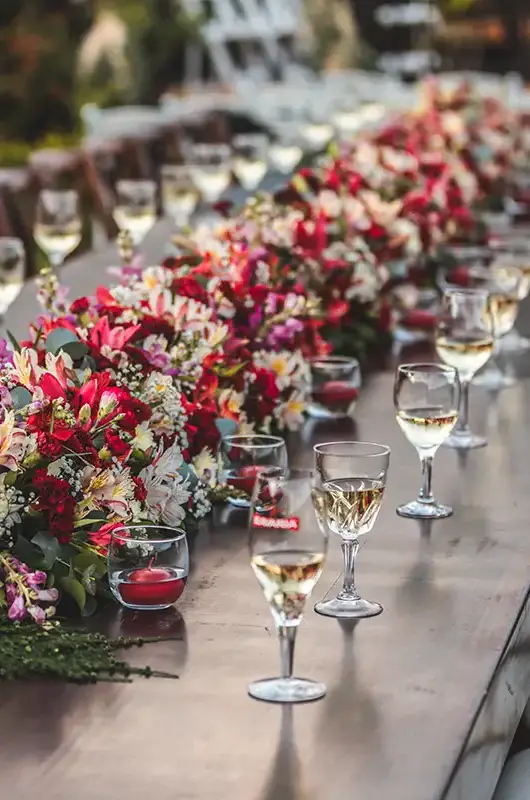
Even though Pinterest, as mentioned earlier, can often be overwhelming and even create false expectations, we highly recommend the platform—and especially our curated inspiration gallery. A digital mood board is easy to create using software or an app designed for this purpose; these are often free and have become very intuitive to use. With these tools, you can create a mood board for your wedding in either a very structured way—with frames and grids—or in a completely eclectic, free-form style. One of the best things about digital wedding mood boards is that you can share the board and work on it together! Whether with your future spouse, wedding planner, or caterer—you can explore inspiration together and gradually turn your ideas into reality.
An Analog Mood Board for Your Wedding
As briefly mentioned earlier, analog mood boards are also invaluable when planning a wedding. Especially if you’re more of a hands-on person or enjoy working not only with paper but also with other materials like napkins and fabrics, a mood board made of cardboard is highly recommended. Working creatively on an analog mood board can be a lot of fun, especially as a team. While with digital design one person usually just sits on the sidelines and can’t really participate, when you’re crafting the analog mood board together, you can inspire each other. Gather plenty of magazines, books, and printouts, but also use craft supplies, napkins, and fabrics—anything that appeals to you and feels right in terms of color and texture can go on the mood board. It’s best to display your finished mood board in your living room—that way, you’ll see your creation every day and get a good sense of what your wedding concept should actually look like.


The 5-Step Plan for a Wedding Mood Board
The mood board originated in the fields of design and marketing and serves to translate abstract ideas, moods, and design directions into a visually tangible form. Like many tools from the marketing world, the mood board follows a proven 5-step plan—and this plan translates perfectly to wedding planning. If you stick to this clear roadmap, your vision will become a cohesive overall concept—and almost nothing can go wrong during the planning process.
- Finding the right words—translating feelings into language: Think about which terms describe the mood you want to create and your wedding style (romantic, elegant, colorful, funny, playful, sophisticated, simple, ...).
- Choose colors and materials: Gather colors, textures, fabrics, flowers, and decor ideas that match the themes you’ve already defined. You can use clippings from magazines, newspapers, books, and the like, but you can also incorporate more tactile elements (such as napkins).
- Organize & Identify the Common Thread: Remove anything that doesn't fit the concept, and look for recurring elements and colors to create a cohesive overall look.
- Design & Adding Thoughtful Details: Create your mood board—whether digitally or on paper—and strategically add special details that tie your concept together. This could be a symbol or motif that serves as a unifying theme throughout your stationery, decorations, and other elements. Take this wedding inspiration, for example, where the focus was on the anchor.
- Review and Share the Big Picture: Take your time to look at your creation, view the image from different angles again and again, and then share your wedding mood board with your partner, vendors, or wedding planner.
Keep at it!
It’s completely normal to feel overwhelmed every now and then when creating a wedding mood board. The sheer number of ideas, colors, and options can quickly feel overwhelming. But even if you think you’ll never finish your mood board—definitely stick with it! Our 5-step plan is a great resource to help you through it. You’ll see that, in the end, a finished mood board will make all the remaining steps of wedding planning so much easier. In the end, you’ll be glad you invested so much time and love into your research. A well-thought-out mood board for your wedding not only captures your vision but also makes every subsequent step in wedding planning easier. A mood board can make the planning process more enjoyable and also serve as a helpful key to creating a cohesive and personal celebration.
Created on
23.11.2022
Updated on
28.1.2026