7 Tips for the Perfect Guest List

For most weddings, the guest list is the biggest hurdle—one that you’d rather put off until the very end. Unfortunately, though, you need to know the approximate number of guests right at the start of wedding planning, because whether it’s a small celebration with 30 people or a grand party with 200 guests plays a major role in both budgeting and choosing the right wedding venue.
Our tips for creating the perfect guest list:
This article covers the following topics:
1. Recognize that this is about YOU
Should you invite Aunt Frida, even though you haven’t seen or heard from her in years? Should Acquaintance A be there just because he’s Colleague B’s best friend? Is it really necessary to invite your cousin’s insufferable girlfriend? If you’re asking yourself questions like these, the answer in 99% of reasonable cases is NO. It’s your day, and you should spend it with the people who are close to you. Even if you risk disappointing one or two people—you alone get to decide who’s invited, and your guests should politely accept that. Remember that every guest costs you money. And just ask yourselves: Do we really want to spend x euros on this person? By the way, the “just invite them and hope they don’t show up anyway” trick doesn’t work in most cases. So it’s better to stick to your own decision!
2. It's better to go overboard
To avoid surprises that could throw your entire plan off track, it’s always smarter to plan for a few more guests—even though it’s possible that one or two might have to cancel at the last minute, for example, due to illness. Aside from the fact that you yourselves might want to invite a few more guests as the year goes on, or that some of your perpetually single friends might suddenly find a partner, it’s even possible that one or two of your guests might show up with a date without asking.


3. Make the "plus-one" decisions
Ideally, you should make it clear to your guests right when you hand out the invitations whether they’re invited alone or with a partner. The easiest way to do this is to label the envelope with the guest’s name(s). If it just says “Maximilian,” then out of courtesy, Maximilian shouldn’t ask whether he can bring his partner. However, since many guests don’t even consider that every additional guest drives up your budget, be prepared for them to ask anyway. Instead of giving in and inviting someone you don’t actually want there, stick to your decision and try to explain it to them. If you bring up the budget issue, they should understand immediately.
4. Believe in your singles
If there are many singles among your guests, please keep in mind that they may have found a partner by the wedding date and would like to bring that person along. Of course, it’s up to you to decide whether they’re allowed to bring their partner. For example, if you haven’t even met them by the wedding date, it’s usually not a requirement—but if you turn them down, they might not understand why.
5. Think of the children
These days, it’s common to specify in the invitations whether or not guests are allowed to bring children. If you don’t want children at your event, you shouldn’t feel bad at all about letting your guests know this or including it in the invitations. There are some very polite ways to phrase this. Essentially, you want your guests to be able to fully enjoy the day and celebrate with you into the early hours of the morning, rather than constantly having to chase after their kids. Most parents are happy for any opportunity to party without their kids for a change—so you can assume that many might even be glad that children aren’t welcome at the wedding. If you’d like to have children present (for example, because you have children of your own and naturally want them to be in good company), check their ages so you can let the venue know if high chairs are needed.


6. Consider splitting it up
If you have more people on your guest list than you can afford, consider splitting up the guests. For example, you could invite everyone to the wedding ceremony and reception, but only some of the guests to the evening celebration. This is actually quite common these days, and guests who are invited only to the ceremony usually understand. In this case, you simply send out two different versions of the invitations. However, the reverse approach is also becoming increasingly popular: only your closest circle attends the wedding ceremony, reception, and dinner, and after dinner, acquaintances join the party. This way, you don’t have to budget for a meal for them—just drinks.
7. Keep it exciting!
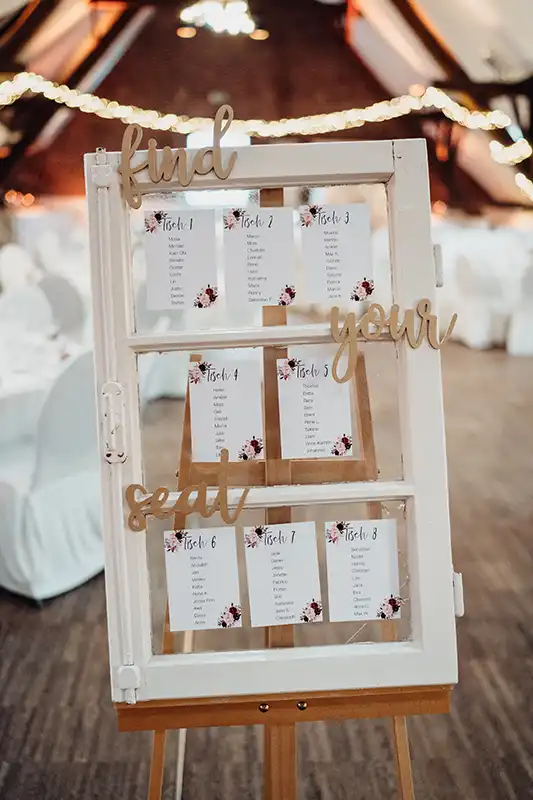
Naturally, people tend to seat groups of friends and family members who know each other at the same table. But then there’s often the risk that many guests (especially the older generation) will stay at the table for a very long time because they’re in their “familiar” surroundings. There’s also the option of mixing guests up randomly in pairs. You seat guests who may not know each other yet—or not very well—but who you think might get along well. That way, interesting conversation topics are guaranteed. And—isn’t the idea that new friendships might form at your wedding just wonderful? Plus, anyone who wants to chat with their friends is practically forced to get up from the table and, if necessary, meet up with them on the dance floor. This keeps things lively throughout your celebration, and no one ends up nodding off at the table.

Created on
23.10.2020
Updated on
10.11.2025